Most Daly City flooding comes from storm drains that can’t keep up, not from rivers. Here’s where it happens, which utility serves you, and who to call for what.
Daly City flooding is mostly storm-drain flooding: during intense winter rain, runoff from the hills arrives faster than aging drains can carry it, and water ponds in low streets, driveways, and ground-level garages. Your tap water comes from the City of Daly City's Department of Water and Wastewater Resources in most of the city, with Cal Water's Bayshore District serving some areas. Call the utility for a break at the street or meter, the City for a flooded street or blocked drain, and a restoration company for water inside your home.
This guide sticks to local facts you can check: which drainage systems serve the city, where flooding has actually happened, how to look up your property's flood zone, and which number to call for which problem. If water is already inside, our flood damage cleanup crews answer around the clock. If you're getting ready for the next storm, the gutter, grading, and sump-pump checklist lives in our atmospheric river flood-prep guide, so we won't repeat it here.
Why Daly City floods: drains, hills, and a lot of pavement
Daly City doesn't have a big river running through town. What it has is steep, built-out hillsides, a ridge that catches Pacific storms, and storm drains that were sized generations ago. When an atmospheric river parks over the Peninsula, the rain falls on rooftops, streets, and driveways that shed it almost instantly. That water heads downhill toward two main drainage systems: the Vista Grande basin on the northwest side of the city and the Colma Creek watershed to the south and east. Where either one backs up, the low spots fill first.
The Vista Grande basin and Lake Merced
According to the Vista Grande Watershed Study prepared by Daly City and San Francisco, the Vista Grande system drains roughly 2.5 square miles of northwestern Daly City and unincorporated San Mateo County. Storm water runs through underground pipes to an open canal beside John Muir Drive, then into a tunnel built in 1897 that carries it out to the beach below Fort Funston. The study notes that during large storms the collection system floods or surcharges, and that flows bigger than the canal and tunnel can handle have historically spilled across John Muir Drive into Lake Merced. That is why homes in the northwest pockets of the city, including the streets near Lake Merced and the Olympic Club, pay close attention to winter storm forecasts.
A fix is underway. The SFPUC's Vista Grande Drainage Basin Improvement project page describes expanding tunnel capacity and routing screened storm water into South Lake Merced, with construction scheduled from 2026 into 2029. Until it's finished, the existing system still sets the limits, so plan as if the old capacity is what you have.
Broadmoor and the Christmas 2025 flash flood
The clearest recent example came early on Christmas morning 2025. NBC Bay Area reported that torrential rain overwhelmed storm drains around 89th Street in Daly City and 88th Street in Broadmoor within minutes, with water rising high enough to lift parked cars. KTVU's follow-up quoted county officials pointing to old, undersized drainage pipes that back up when a heavy burst of rain arrives, and naming the Vista Grande canal project as the long-term fix. If you live in or near Broadmoor, that storm is the scenario to plan around: fast, intense rain at night with little warning.
Colma Creek on the south and east side
South and east of the Vista Grande basin, runoff drains toward Colma Creek. OneShoreline's Colma Creek Watershed Plan describes a watershed of about 16.6 square miles running from San Bruno Mountain through Daly City, Colma, South San Francisco, Pacifica, and San Bruno to the Bay. By the 1960s and 70s most of the creek had been confined to concrete channels, and the plan notes that this infrastructure wasn't designed for the higher tides and heavier rain now expected. Creek flooding has historically been worst downstream in South San Francisco, where FEMA has funded channel improvements. In Daly City, neighborhoods on lower ground near the Colma Creek drainage, such as Sterling Park, collect runoff from the slopes around them during big storms.
Hillside runoff, ground-level garages, and flat ground
Plenty of local flooding has nothing to do with a creek. Many Daly City homes, including the 1940s-60s Doelger tract houses, have a street-level garage with living space above and a driveway sloping toward the garage door. When the curb inlet clogs or the street gutter overflows, water runs down the driveway and under the door. It soaks boxes, water heaters, and laundry areas, and it gets into any in-law unit built into the garage level. Downhill lots catch the runoff from the lots above them. On level ground, like the Bayshore flats near the Cow Palace, there's almost no slope to move standing water toward a drain, so it sits.

How to check your property's flood zone
FEMA's official flood maps are free to search. Go to the FEMA Flood Map Service Center, type in your street address, and open the current Flood Insurance Rate Map for your parcel. The map shows whether you're in a mapped high-risk zone, which matters for lenders and flood insurance pricing. Keep two limits in mind. First, the maps focus on creek, river, and coastal flooding, so a low or minimal-risk designation doesn't mean a storm drain can't back up on your block, as Broadmoor showed. Second, the map won't show your own lot's drainage: a reverse-sloped driveway or a garage slab below street level can flood in a zone the map rates as low risk.
Who is the water company in Daly City?
For most residents, it's the city. The City of Daly City Department of Water and Wastewater Resources runs the local system and says it gets about half its water from San Francisco's regional system, which includes Hetch Hetchy and the local Crystal Springs watersheds. The other half comes from local groundwater wells. Some addresses are served by a private utility instead: Cal Water's Bayshore District lists Daly City, Broadmoor, and Colma among the communities it serves. Despite the name, Cal Water's Bayshore District is a service area covering several Peninsula cities. It has nothing to do with the Bayshore neighborhood. The quickest way to find out who serves you is to look at who sends your water bill.
| Utility | Who it serves | Call them for |
|---|---|---|
| City of Daly City Water & Wastewater Resources | Most homes and businesses billed by the City of Daly City | Water main breaks, water spraying from the street or meter box, shutting water off at the meter, sewer emergencies |
| Cal Water, Bayshore District | Customers billed by Cal Water, including some parts of Daly City, Broadmoor, and Colma | The same street- and meter-side problems, using the phone number on your Cal Water bill |
| SFPUC | Wholesale supplier to Daly City; retail utility for San Francisco addresses | Daly City customers call the City or Cal Water, not the SFPUC; San Francisco residents call the SFPUC |
| PG&E | Gas and electric service | Gas smell, downed lines, or a flooded electrical panel or meter |
Who to call: the street, the meter, or inside your home
The right call depends on where the water starts. The City's Storm Preparedness page lists 9-1-1 for emergencies, (650) 991-8200 for water and sewer emergencies, (650) 991-8119 for non-emergencies during business hours, (650) 992-1225 after hours, and PG&E at (800) 743-5002. Numbers can change, so confirm them on that page and save them in your phone before the rainy season.
- Water bubbling up from the street, sidewalk, or the meter box: that's on the utility's side. Daly City customers call Water & Wastewater Resources at (650) 991-8200. Cal Water customers call Cal Water.
- You need the water shut off at the meter: Daly City's plumbing repairs page asks residents to call (650) 991-8200, available 24 hours, rather than operate the meter themselves. Damage to the service line on the property side can be billed to the owner.
- A clogged storm drain or a flooded street with no immediate danger: the City's sewer and storm FAQ directs clogged storm drains to the Street Division at (650) 991-8097 during business hours. Use the after-hours line otherwise.
- Water rising toward people, cars, or electrical equipment: call 9-1-1. Don't drive or walk through moving water.
- A leak inside your walls, under a sink, or at the water heater: that's a plumber's job, and Daly City leak repairs on your side of the meter are the owner's responsibility. If you can't find the leak, professional leak detection traces it without opening walls blindly.
- Water already inside your home: shut off your main valve if it's safe, then call a restoration company to extract and dry. Our guide to who to call first when your home floods walks through the order.
Sandbags: where Daly City residents get them
The City's Storm Preparedness page lists free sandbag pickup for residents at the Water & Wastewater Resources parking lot at 153 Lake Merced Boulevard and at the Public Works corporation yard entrance at 798 Niantic Avenue. It asks for proof of residency, sets a per-resident limit, and suggests filling bags only halfway so they're liftable. San Mateo County's winter weather preparedness page keeps a countywide list, and the two sources don't always show the same hours. Supplies run low before big storms, so check the City or County website a day or two ahead and pick bags up early. For how to place them at a garage door, see the prep guide.
Flood insurance: the gap most homeowners don't know about
Standard homeowners and renters policies exclude flood, meaning surface water that rises from outside and enters the home. Water that rushes down a driveway and under the garage door usually falls into that category. Flood coverage is sold separately, most often through the National Flood Insurance Program, which you can research at FloodSmart.gov. NFIP policies generally carry a waiting period before coverage starts, so buying one the day a storm is forecast won't help that storm. Sewer backup is another separate gap that usually needs its own endorsement. For the details of what a California policy does and doesn't cover, read does homeowners insurance cover water damage in California. If you do have a covered loss, our step-by-step guide on how to file a water damage insurance claim shows what to document first.
After the water comes in: what flood cleanup involves
Storm water that has crossed streets, yards, and garage floors is treated as Category 3, or grossly contaminated, water under the IICRC S500 standard. That changes the cleanup. Porous materials it soaked, such as carpet and pad, the bottom of drywall, insulation, and cardboard, usually have to be removed rather than dried. Hard surfaces are cleaned and disinfected, and the structure is then dried with dehumidifiers and air movers while moisture readings are logged until the materials reach a dry standard. Ground-level rooms and in-law units below grade get the same process through our flooded basement cleanup service. When wind-driven rain also got in through the roof or windows, storm damage restoration covers the tarping and the drying together.
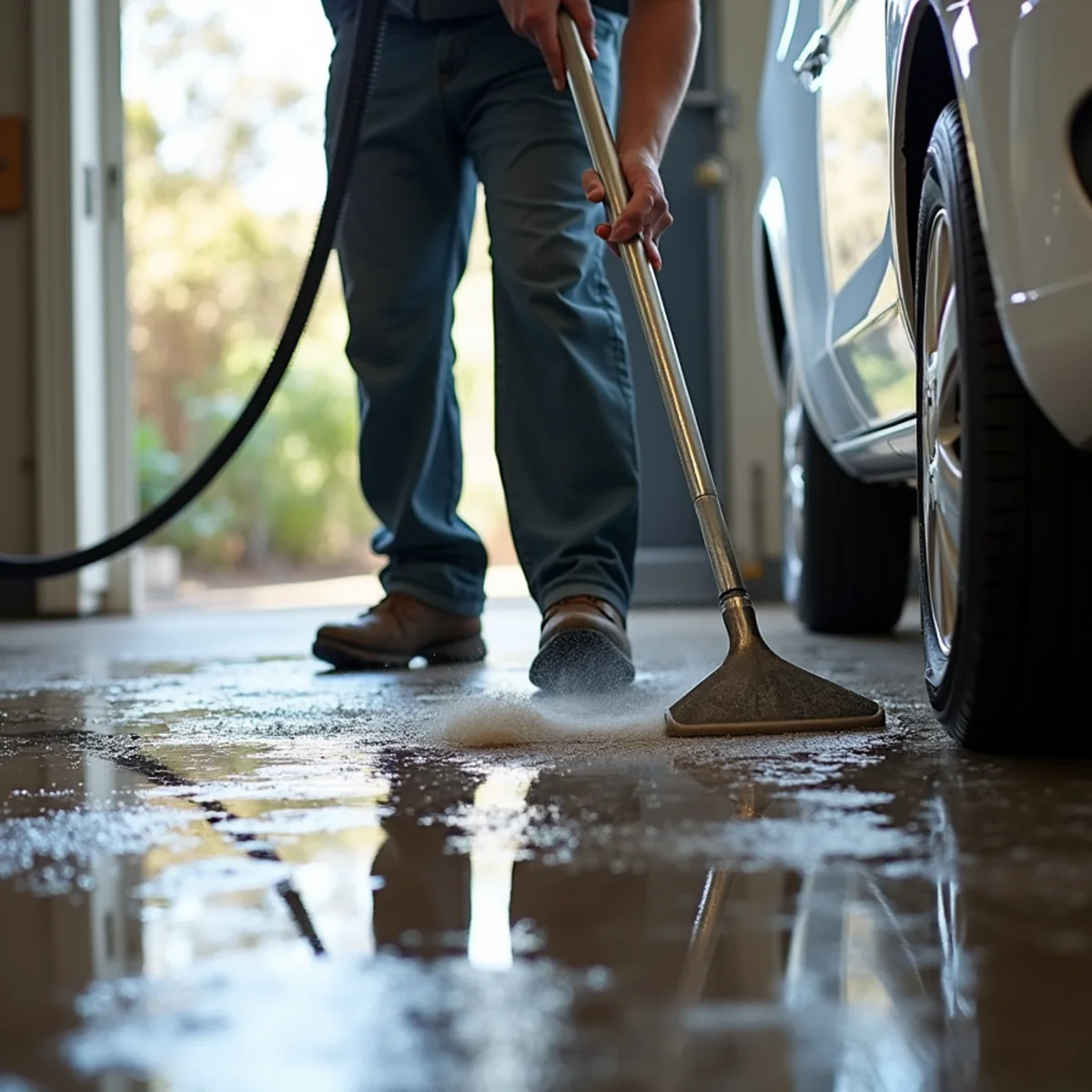
Act quickly. The EPA advises drying water-damaged areas within 24 to 48 hours to prevent mold growth, and garages and lower floors in Daly City's foggy neighborhoods dry slowly on their own. Before you touch anything, photograph the water line on walls, the damaged contents, and the street conditions outside.
Every Daly City neighborhood floods for its own reasons — our Daly City neighborhood guide summarizes the local risks area by area. If storm water got into your garage, in-law unit, or lower floor, we'll come out for a free inspection, map where the moisture went with meters and a thermal camera, and tell you what can be dried and what has to go. Call Water Damage Daly City at (201) 277-9344, day or night.
Frequently asked questions
It depends on the parcel. Much of Daly City sits on hillsides outside FEMA's mapped high-risk zones, but that doesn't make a property flood-proof. Most local flooding comes from storm drains and runoff that FEMA maps don't capture, as the Christmas 2025 flash flood in Broadmoor showed. Look up your exact address on the FEMA Flood Map Service Center, then judge your lot: where the driveway slopes, how high the garage slab sits compared with the street, and whether the nearest storm inlet keeps up in heavy rain.
If the City of Daly City bills you for water, call Water & Wastewater Resources at (650) 991-8200. The City lists that number for water and sewer emergencies, and its plumbing repairs page says it's available 24 hours for shutting water off. If Cal Water bills you, use the emergency number on your Cal Water bill. If water is threatening people or electrical equipment, call 9-1-1 first. Confirm the numbers on the City's Storm Preparedness page before storm season, since they can change.
The inlet may be clear but already full. When a large storm surcharges the pipes downstream, water can back up out of the inlet or stay in the gutter. A driveway that slopes toward the garage then sends that water to the door. Worn door seals, a garage slab below street level, or a downspout dumping next to the driveway make it worse. Watch where water goes during a steady rain. A trench drain, a raised threshold, or regrading often fixes it, and a plumber or drainage contractor can tell you which.
That's your decision with your agent, but know the gap first. Standard homeowners policies exclude flood, so surface water entering from outside generally isn't covered without a separate flood policy. NFIP policies usually have a waiting period before they take effect, so buy before the rainy season, not during a storm warning. Homes at the bottom of a slope, near Colma Creek drainage, or with a garage-level living space are the ones where the question deserves a careful look.